Sitemap
A list of all the posts and pages found on the site. For you robots out there, there is an XML version available for digesting as well.
Pages
Posts
publications
Schwermut Und Leichtigkeit: Über Die Rolle Der Schwerkraft in Videospielen
Published in Paidia – Zeitschrift Für Computerspielforschung, 2015
Based on research done during my BA, I argue in this German-language paper that games’ frequent defiance of gravity reflects a broader technological imaginary of digital weightlessness which risks erasure of material/ecological costs while staging a productive tension between lightness and heaviness.
Recommended citation: Stürmer, Milan. 2015. "Schwermut Und Leichtigkeit: Über Die Rolle Der Schwerkraft in Videospielen." Paidia – Zeitschrift Für Computerspielforschung.
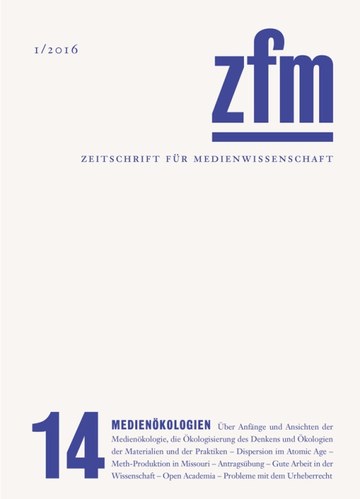
Medienökologien fürs Anthropozän
Published in Zeitschrift für Medienwissenschaft, 2016
Co-authored with Isabell Schrickel, this review essay looks at the discourse around the Anthropocene in media studies and covers Jussi Parikka’s The Anthrobscene (2014), A Geology of Media (2015), as well as McKenzie Wark’s Molecular Red. Theory for the Anthropocene (2015).
Recommended citation: Schrickel, Isabell, and Milan Stürmer. 2016. "Medienökologien Fürs Anthropozän." Zeitschrift Für Medienwissenschaft 14: 180–85.
Mann and Wainwright’s Climate Leviathan
Published in ‘Culture, Politics and Global Justice’ (CPGJ)-Blog at the University of Cambridge, 2020
Many people have recently confessed to the strange feeling of relief they felt when the government finally decided to put them under house arrest. Under normal circumstances, this sort of reaction would be unthinkable, but this is a crisis and, in a crisis, it is time for the state to step up to the plate and do its job. Its job of governing us. Properly.
Recommended citation: Stürmer, Milan. 2020. "Mann and Wainwright’s Climate Leviathan." ‘Culture, Politics and Global Justice’ (CPGJ)-Blog at the University of Cambridge. https://cpgjcam.net/reading-groups/self-isolation-reading-group/mann-wainwrights-climate-leviathan/.
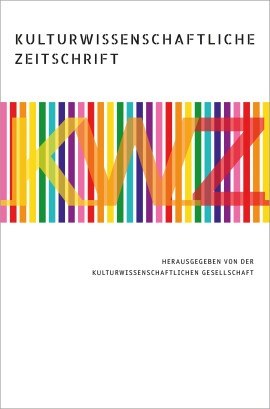
Die Errettung der Zivilisation: Über das Versprechen der Onto-Epistemologie des Neuen Animismus
Published in Kulturwissenschaftliche Zeitschrift, 2021
This is an open-access, German-language paper in which I argue that the promise of the onto-epistemology of New Animism is nothing less than to save civilization.
Recommended citation: Stürmer, Milan. 2021. "Die Errettung Der Zivilisation: Über Das Versprechen Der Onto-Epistemologie Des Neuen Animismus." Kulturwissenschaftliche Zeitschrift. 6 (2): 39–56.

Fit for Finance
Published in Parole Compendium: Form Follows Finance, 2021
Parole.cc is a website that commissions and publishes new critical texts and media about contemporary culture, in the form of design critique. In this contribution to the compendium on design and finance, I think through the organic critique of finance in design following Lewis Mumford, Thorstein Veblen, and the critique of political economy by Jonathan Nitzan and Shimshon Bichler.
Recommended citation: Stürmer, Milan. 2021. "Fit for Finance". Parole Compendium: Form Follows Finance. https://parole.cc/compendiums/form-follows-finance/fit-for-finance/.
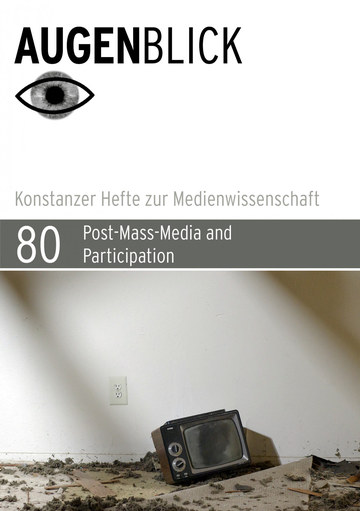
Post-Mass Media and Participation (Special Issue)
Published in Augenblick, Schüren Verlag, 2021
This special issue examines how early career researchers adopt and adapt the concept of post-media for their work today to allow a reframing of the question of participation after the end of the 20th century.
Recommended citation: Stürmer, Milan, and Michel Schreiber, eds. 2021. "Post-Mass Media and Participation (Special Issue)." Augenblick: Konstanzer Hefte Zur Medienwissenschaft, 80.
Post-Mass Media and Participation
Published in Post-Mass Media and Participation (Special Issue), 2021
Michel Schreiber and I survey how early career researchers adopt and adapt the concept of post-media for their work today to allow a reframing of the question of participation after the end of the 20th century.
Recommended citation: Stürmer, Milan, and Michel Schreiber. 2021. "Post-Mass Media and Participation (Special Issue)." Augenblick: Konstanzer Hefte Zur Medienwissenschaft, 80: 5–16.
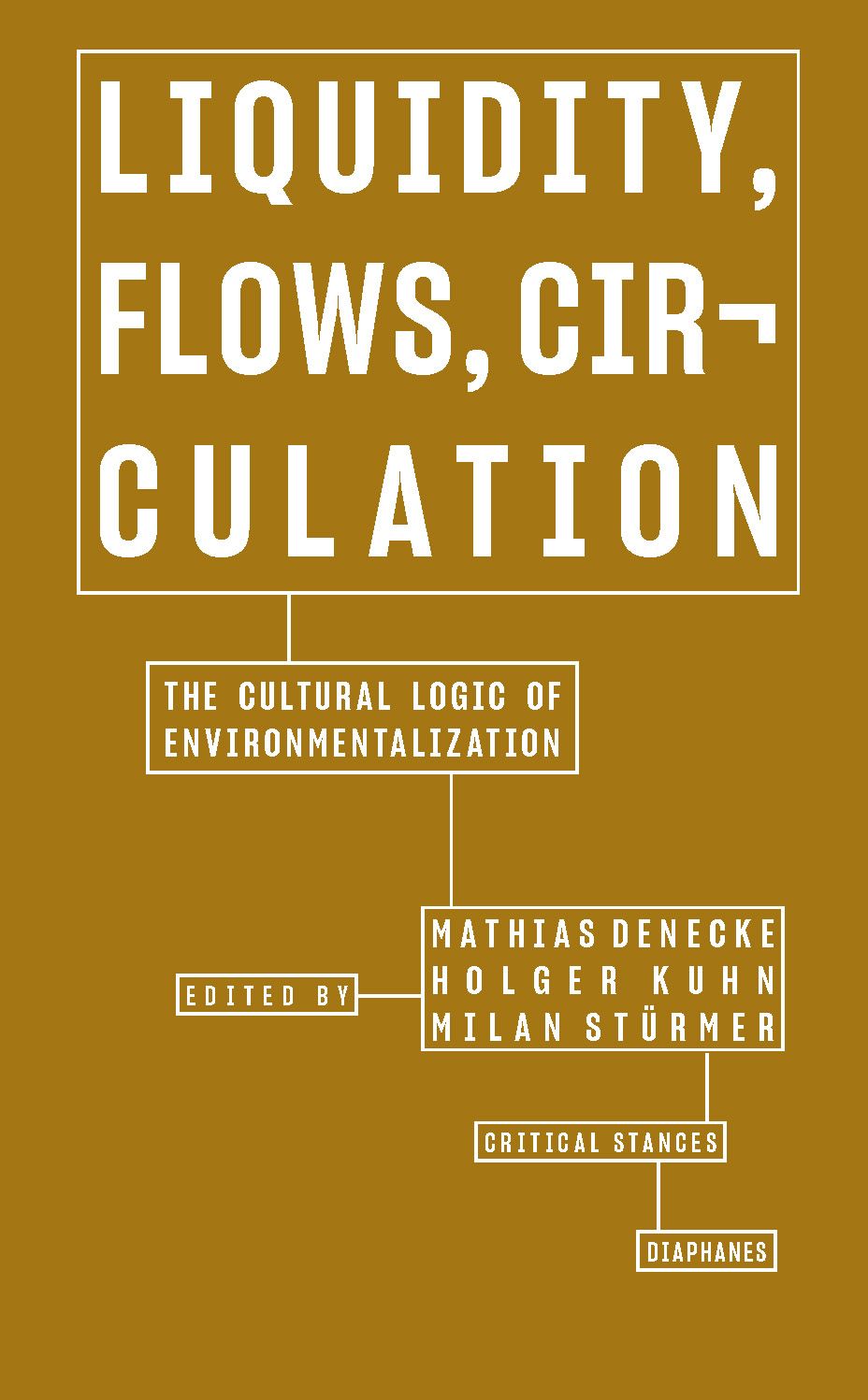
Liquidity, Flows, Circulation: The Cultural Logic of Environmentalization
Published in Critical Stances, Diaphanes/University of Chicago Press, 2022
Placed at the intersection of art, media, and cultural studies as well as economic theory, this edited volume investigates the cultural logic of environmentalization. As flows, circulations, and liquidity resurface in all aspects of recent culture and contemporary art, we investigate the hypothesis of a genuine cultural logic of environmentalization through these three concepts.
Recommended citation: Stürmer, Milan, Holger Kuhn, and Mathias Denecke, eds. 2022. Liquidity, Flows, Circulation: The Cultural Logic of Environmentalization. Diaphanes, University of Chicago Press.
The Cultural Logic of Environmentalization
Published in Liquidity, Flows, Circulation: The Cultural Logic of Environmentalization, 2022
In this introduction, we investigate why the notions of liquidity, flow, and circulation exert an irresistible lure on scholars and artists engaged in depicting the principles that undergird the workings of our contemporary world. Drawing on Fredric Jameson’s work, we ask whether the concepts of liquidity, flow, and circulation might provide a useful means to grasp the cultural logic of today’s capitalism.
Recommended citation: Denecke, Mathias, Holger Kuhn, and Milan Stürmer. 2022. "The Cultural Logic of Environmentalization." In Liquidity, Flows, Circulation: The Cultural Logic of Environmentalization, edited by Milan Stürmer, Holger Kuhn, and Mathias Denecke. Diaphanes, University of Chicago Press.
Relationen Denken: Teilhabe, Verwandtschaft und Innere Beziehungen nach Marilyn Strathern
Published in Mediale Teilhabe: Partizipation zwischen Anspruch und Inanspruchnahme, 2023
This open-access, German-language chapter is for those interested in the relational turn and the microvocabulary of dissolution that we can find in the New Kinship Studies generally and particularly in the ethnography of Marilyn Strathern. Following Strathern, I am asking what appears and disappears as a cultural resource for thinking about relations.
Recommended citation: Stürmer, Milan. 2023. "Relationen Denken: Teilhabe, Verwandtschaft Und Innere Beziehungen Nach Marilyn Strathern." In Mediale Teilhabe: Partizipation Zwischen Anspruch Und Inanspruchnahme, edited by Beate Ochsner. Meson Press.
Whitehead’s Ethics: Fill in the Blanks
Published in Process Studies, 2023
The paper examines Whitehead’s singular guest lecture in Richard Clarke Cabot’s seminar in social ethics.
Recommended citation: Bella, Daniel, and Milan Stürmer. 2023. "Whitehead's Ethics: Fill in the Blanks." Process Studies 52 (2): 179–200. https://doi.org/10.5406/21543682.52.2.03.
Protokoll 05: Banal Input/Output System
Published in ChatGPT und andere 'Quatschmaschinen'. Gespräche mit Künstlicher Intelligenz, 2023
Co-written with Mathias Denecke, this open-access, German-language paper contributes to an experimental collection that aims to document the passage in media history into a new era of ubiquitous AI.
Recommended citation: Denecke, Mathias, and Milan Stürmer. 2023. "Protokoll 05: Banal Input/Output System." In ChatGPT und andere 'Quatschmaschinen'. Gespräche mit Künstlicher Intelligenz, edited by Anna Tuschling, Andreas Sudmann, and Bernhard J. Dotzler. Transcript Verlag. https://doi.org/10.14361/9783839469088-006.
Inheriting Cosmopolitics: Pericles, Whitehead, Stengers
Published in Theory, Culture & Society, 2023
This open-access paper deals with the commercial political ontology of Isabelle Stengers by tracing it through the works of Alfred North Whitehead back to Pericles.
Recommended citation: Stürmer, Milan, and Daniel Bella. 2023. ‘Inheriting Cosmopolitics: Pericles, Whitehead, Stengers’. Theory, Culture & Society 40 (3): 3–21. https://doi.org/10.1177/02632764221092300.
Review of The Influencer Industry: The Quest for Authenticity on Social Media
Published in LSE Review of Books, 2023
In this review, we go through Emily Hund’s outstanding analysis of the economics of influence, which offers a sophisticated theoretical contribution at a point in history when the influencer industry has penetrated the mainstream to an unprecedented degree.
Recommended citation: Carrigan, Mark, and Milan Stürmer. 2023. "The Influencer Industry: The Quest for Authenticity on Social Media." LSE Review of Books. https://blogs.lse.ac.uk/lsereviewofbooks/2023/08/07/book-reviewthe-influencer-industry-the-quest-for-authenticity-on-social-media-emily-hund/.
Review of Resisting AI: An Anti-fascist Approach to Artificial Intelligence
Published in LSE Review of Books, 2023
In this review, we discuss Dan McQuillan’s call for a restructuring of artificial intelligence which prioritises the common good over an algorithmic optimisation that reinforces the marginalisation of vulnerable groups.
Recommended citation: Stürmer, Milan, and Mark Carrigan. 2023. "Resisting AI: An Anti-fascist Approach to Artificial Intelligence – review." Impact of Social Sciences (LSE Impact Blog). https://blogs.lse.ac.uk/impactofsocialsciences/2023/11/16/resisting-ai-an-anti-fascist-approach-to-artificial-intelligence-review/.
Review of Generative AI for Academics
Published in Postdigital Science and Education, 2025
The challenge Carrigan’s book leaves for all of us is to create broader cultures of scholarship that would be conducive to reflective individual practice, while mitigating the collective harm. This, however, is not a question of a more or less thoughtful use of GenAI systems, but of rethinking and reforming the ways in which we ‘do university’.
Recommended citation: Stürmer, Milan. 2025. "Review of Mark Carrigan (2025). Generative AI for Academics." Postdigital Science and Education. https://doi.org/10.1007/s42438-025-00580-x.
Whitehead’s Ethics: Fill in the Blanks
Published in Whitehead at Harvard, 1925-1927, 2025
In this paper, Daniel Bella and I examine Whitehead’s singular guest lecture in Richard Clarke Cabot’s seminar in social ethics. This paper was already published in Process Studies in 2023, but has been updated for this collected volume in which Whitehead-scholars examine the significance of The Harvard Lectures of Alfred North Whitehead, 1925–1927: General Metaphysical Problems of Science.
Recommended citation: Stürmer, Milan, and Daniel Bella. 2025. "Whitehead's Ethics: Fill in the Blanks." In Whitehead at Harvard, 1925-1927, edited by Joseph Petek and Brian G. Henning, 153–173. Edinburgh University Press. https://doi.org/10.1515/9781399550123-012.
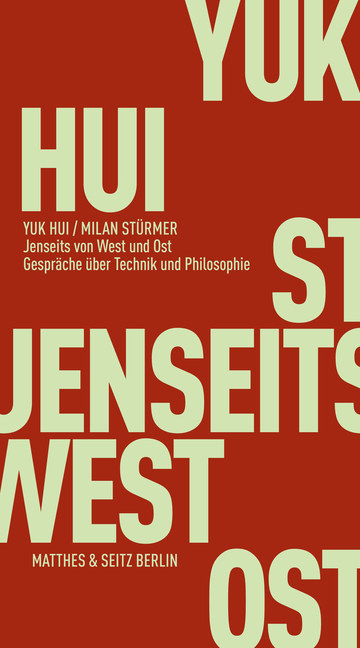
Jenseits von West und Ost: Gespräch über Technik und Philosophie
Published in Fröhliche Wissenschaft, Matthes & Seitz, 2025
This is a book-length conversation between Yuk Hui and myself, which aims to serve as both an introduction to Hui’s philosophy, as well as a commentary on a specific historical moment after the pandemic.
Recommended citation: Hui, Yuk, and Milan Stürmer. 2025. Jenseits von West und Ost: Gespräch über Technik und Philosophie. Matthes & Seitz Berlin.
Translations

Japanese (2026): 東西の彼岸 新冷戦時代におけるテクノロジーの哲学
Translated by 中村徳仁. Chūōkōron-Shinsha. ISBN 978-4-12-006076-2.
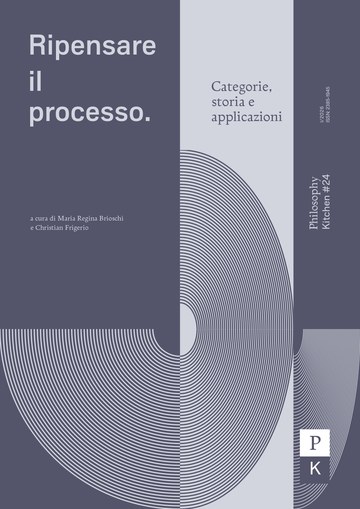
The Function of Unreason. Technology, Ecology, and Economic Process
Published in Philosophy Kitchen, 2026
I reinterpret Bernard Stiegler’s late neganthropological project through Whitehead’s concept of reason, tracing the role of Nicholas Georgescu-Roegen’s bio-physio-economics in this encounter. The article connects technology, ecology, and economy through reason as a capacity to orient novelty toward living better, and reads the Neganthropocene as a programme for sociotherapy.
Recommended citation: Stürmer, Milan. 2026. “The Function of Unreason. Technology, Ecology, and Economic Process.” Philosophy Kitchen 24: 203–216. https://doi.org/10.13135/2385-1945/13878.
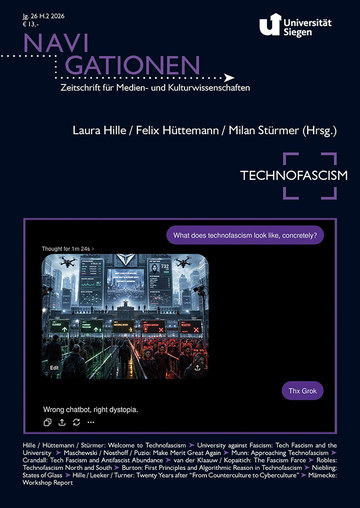
Technofascism (Special Issue)
Published in Navigationen 26 (2), universi - Universitätsverlag Siegen, 2026
Co-edited with Laura Hille and Felix Hüttemann, this special issue examines the connections between technology and contemporary authoritarian politics through contributions on digital infrastructures, meritocracy, universities, neofeudalism, and technofascism’s histories and international variations.
Recommended citation: Hille, Laura, Felix Hüttemann, and Milan Stürmer, eds. 2026. Technofascism. Special issue of Navigationen: Zeitschrift für Medien- und Kulturwissenschaften 26 (2). Siegen: universi - Universitätsverlag Siegen. https://doi.org/10.25819/ubsi/11107.
Welcome to Technofascism
Published in Navigationen: Zeitschrift für Medien- und Kulturwissenschaften, 2026
In our introduction to the special issue Technofascism of Navigationen, we historicise the concept of technofascism, examine how technological systems and imaginaries reinforce authoritarian politics, and introduce the issue’s contributions, asking what criticism can do when reactionary tendencies are increasingly proclaimed openly.
Recommended citation: Hille, Laura, Felix Hüttemann, and Milan Stürmer. 2026. "Welcome to Technofascism." Navigationen: Zeitschrift für Medien- und Kulturwissenschaften 26 (2): 7–18. https://doi.org/10.25819/ubsi/11107.
talks
Animismus Und Politische Ökonomie
Published:
The Cultural Logic of Environmentalization
Published:
Together with Mathias Denecke and Holger Kuhn we organised a four-day conference on the concepts of liquidity, flow, and circulation in art and politics with keynotes from Annie McClanahan (UC Irvine), Esther Leslie (Birkbeck), Yvonne Volkart (FHNW Basel), and a video-presentation by director Ursula Biemann.
Outlines of the Current Capital-Form
Published:
Together with Erich Hörl, Michel Schreiber and Roberto Nigro, we organised a conference dedicated to outlining the contours of the current capital-form. Invited speakers included, amongst others, Leopoldina Fortunati (Udine), Will Davies (Goldsmiths), Anselm Jappe (Rome), Alessandra Mezzadri (SOAS), and Andrea Fumagalli (Pavia). As part of the conference, we organised a screening of Oeconomia followed by a director’s Q&A with Carmen Losmann.
Technology and The State: The 200th anniversary of Hegel’s Philosophy of Right
Published:
Organised with Yuk Hui and Gregory S. Moss, we dedicated a workshop to the question of technology in Hegel’s philosophy. Speakers included Joel Bock (De Paul University), Anna Winckelmann (Higher School of Economics), Christoph Görlich (Leuphana University), Armin Schneider (Humboldt University), Fernando Wirtz (University of Tübingen) and Anna Longo (Collège International de Philosophie).
Disrupting the Post-Pandemic University
Published:
Work-in-Process
Published:
From 2023 to 2025, together with Lennart Posch and Daniel Bella, I co-organized a regular seminar series for the European Society for Process Thought. This series featured invited researchers discussing their work-in-progress and was meant as a hybrid between a seminar and a community event for all those working in process thought.
Keynes and the Teleonomics of Debt
Published:
Whitehead’s Footnotes
Published:
Together with Melanie Sehgal, Michael Halewood, and Daniel Bella, we organised a workshop systematically working through all the footnotes in Whiteheads Process and Reality. Participants included Didier Debaise (Bruxelles), Nicholas Gaskill (Oxford), Michael Halewood (Essex), Tina Röck (Dundee), Michael Thomas (Amsterdam), and Svenja Schmitz (Düsseldorf).
What is Technology?
Published:
Kreativität und Entropie. Whitehead in der zeitgenössischen Medien und Technikphilosophie
Published:
AI as normal Mnemotechnology
Published:
AI and the Political Economy of Automation
Published:
Thinking With the Past: A Whiteheadian Pedagogy
Published:
Teaching the history of philosophy should train us to think with the past rather than merely about it. In this talk, Daniel Bella and I sketch how Whitehead is not just committed to this approach in his published writings, but also practiced it in the classroom and instructed his students to do so too. We reconstruct what Whitehead actually does with the history of philosophy and, from there, draw out its present pedagogical relevance. The key outcome is not consensus but a widening generality that interrupts our provincial habits and equips us for intellectually generous forms of inquiry.
Cultures of Process. Of Lone Geniuses and Emergent Novelty
Published:
In this conference paper, I advance a non-agentic, process-oriented account of novelty that complements social-ontological analyses of LLMs while resisting both techno-determinism and romantic individualism. Attributing creativity to the products of an LLM, therefore, is not a verdict on transformer software per se but a reflection of how its outputs are woven into ongoing cultural processes of novelty selection and valuation. Statistical variations generated by the model gain the status of “creative” only when broader cultural processes recognise, circulate, and stabilise them within existing repertoires of interpretation and use. Creativity therefore appears at the interface where algorithmic stochasticity meets socio-cultural selection.
A Decade of Bifurcation: Physical Perceptivity and the Principle of Solidarity
Published:
In this talk, I trace the term “bifurcation” through Whitehead’s work in the 1920s as he slowly moves toward his metaphysical system in Process and Reality. Paying particular attention to his lectures at Harvard between 1924 and 1927, I reconstruct Whitehead’s various uses of the term just as it disappears from his published writings. I end by posing the (speculative) question of why Whitehead largely abandons the term to the research workshop as a topic for discussion.
Full Programme Here
Kritik des reinen Gefühls [Critique of Pure Feeling] Permalink
Published:
The conference brought together perspectives from media theory, aesthetics, philosophy, sociology, art, and chemistry to examine the relations between sensory perception, environments, and technical sensors. With particular attention to smell and taste, it explored how digital technologies reshape sensory perception and its mediation. My contribution focused on Whitehead’s theory of feeling and sensing and the question of mediation through organs.
Both British and Emergentist: Whitehead’s Account of Diachronic Emergence Permalink
Published:
In this paper, Daniel Bella and I argued that Whitehead offers an account of diachronic emergence within the fundamental level of reality. We compared this account with Paul Humphreys’s conception of emergence as fusion and argued that Whitehead’s account cannot be reduced to synchronic emergence.
The Varieties of Technological Feeling: Process Philosophy, Technodiversity, and AI-Slop
Published:
In this talk for the –1 Digital Lab Séances, I develop a process-philosophical reading of the concept of technodiversity, focussing on processes of technodiversification. How do we open up the question of creativity without falling into a kitschified propositionalism? And what conditions that creativity?
Inference Rationing: or, the Season’s Ill Permalink
Published:
This interdisciplinary workshop explored what an AI crash might look like. My contribution examined how inference rationing under economic and energy constraints could leave everyday environments and infrastructure slower, more forgetful, and less reliable.
Civilizing AI: Common Sense and Abstraction in a Mechanised Society Permalink
Published:
Drawing on Isabelle Stengers’s call to civilize modernity, I asked what it would mean to civilize AI and the abstractions it produces. I brought Whitehead’s account of civilization as transmission that preserves freedom for successors into dialogue with Lewis Mumford’s critique of the megamachine, focusing on the abstractions that govern contemporary LLM architectures.
Misbehaving effects. The Mechanical Magic of Organic Machines
Published:
In this talk, I trace the dream of intelligent machinery as a specifically modern magic: the promise of effects that exceed their mechanical causes. Against accounts that reduce technological power to prediction and control, I distinguish the ambition to know what will happen from the construction of organic machines capable of reacting to what happens. Power, on this account, lies in an unequal capacity to keep reacting and creating, rather than in an all-encompassing plan. The talk was part of a conversation with Simone C. Niquille and Dave Murray-Rust, moderated and organised by Andrea Muniáin and Paula Ramos Mollá.
Democracy, Big Tech and Technofascism Permalink
Published:
At Democracy: Dead or Alive?, I discussed technofascism with Eva Rovers and Stan Boeve, drawing on materials collected for the recently published special issue Technofascism that I have co-edited with Laura Hille and Felix Hüttemann.